
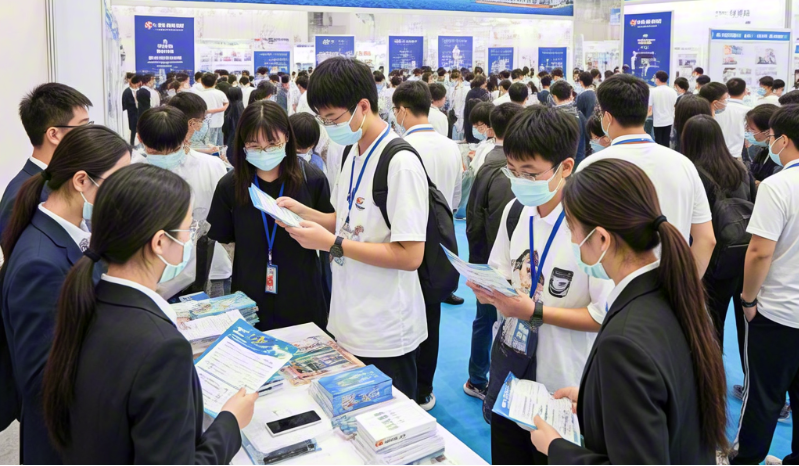
In today’s rapidly evolving global education landscape, studying in Asia, with its core advantages of geographical proximity, cultural affinity, and excellent cost-effectiveness, is becoming an increasingly popular choice for Chinese students seeking to broaden their international horizons and enhance their competitiveness. Compared to Europe and America, studying in Asia is not only closer to home in terms of time and space, reducing the challenges of cross-cultural adaptation, but also offers students a “low-cost, high-return” growth path through diverse educational systems, cutting-edge programs, and abundant practical opportunities. The recently held Asian Study Abroad Expo brought together top universities, educational institutions, and industry experts from various Asian countries. Through policy interpretation, case studies, and one-on-one consultations, it built a bridge for students to access high-quality educational resources across Asia—from the science and innovation of Japan and South Korea to the multiculturalism of Southeast Asia, from Singapore’s financial elite training to Malaysia’s “twin programs”—the rich choices available in Asia are redefining the value of “studying near home.”
The quality of education and the level of internationalization in Asia are the fundamental reasons for its attractiveness. Singapore, a benchmark for education in Asia, boasts its National University of Singapore and Nanyang Technological University, consistently ranking among the top 20 universities globally. Its programs in finance, engineering, and computer science are exceptionally strong, with curricula closely aligned with industry needs. Graduates enjoy an employment rate exceeding 90%, and their salaries are among the highest in Asia. Japan, leveraging the academic strength of its seven Imperial Universities, including the University of Tokyo and Kyoto University, holds a leading global position in materials science, robotics, and medicine. Its “research university + industry joint training” model provides students with a complete closed loop from theory to practice, with many students being recruited by renowned companies like Sony and Toyota even before graduation. South Korea’s semiconductor, electronic engineering, and art design programs are also globally renowned. Universities like Seoul National University and Yonsei University collaborate extensively with companies like Samsung and LG, allowing students to participate in cutting-edge research projects and gain practical experience. Furthermore, Malaysia’s “twin degree” model (joint programs with universities in the UK, US, and Australia) allows students to obtain internationally recognized degrees at a lower cost. Business programs at institutions like Singapore Management University and the Hong Kong University of Science and Technology, with their close ties to Wall Street and Hong Kong’s Central district, have become cradles of financial elites. Universities in these countries not only boast strong academic programs but also help students build global networks and enhance cross-cultural communication skills through international exchange programs and dual-degree programs.
Cultural familiarity and low adaptation costs are another significant, albeit often overlooked, advantage of studying in Asia. For Chinese students, Asian countries offer fewer differences from China in terms of language, food, and lifestyle, effectively reducing culture shock and adaptation pressure. For example, while Japan and South Korea primarily use their native languages for instruction, most universities offer Chinese-language services, and the large Chinese student population on campus forms a natural support network. Singapore and Malaysia, on the other hand, generally use English as the medium of instruction while preserving Chinese cultural traditions, with vibrant festivals like Chinese New Year and Mid-Autumn Festival, allowing students to improve their English skills and quickly integrate into local life. Furthermore, the geographical advantages of studying in Asia are significant—flights from major Chinese cities to Tokyo, Seoul, and Singapore take only 2-5 hours, reducing travel costs for parents and students and fostering a greater sense of security. This “close to home” convenience allows many students to focus more on their studies and personal growth, rather than the mundane details of adapting to life.
Faced with diverse options for studying in Asia, students need to develop strategies that consider their own interests, career plans, and family circumstances. For students seeking academic depth and research opportunities, top universities in Japan and Singapore offer world-class research platforms; for those hoping to enter multinational corporations or the financial industry, business and engineering programs in South Korea and Singapore offer greater employment advantages; and for students with limited budgets but a desire for an international experience, twinning programs in Malaysia or international colleges in Thailand are highly cost-effective options. The study abroad expo is not only an information hub but also a resource-matching platform—through direct communication with university admissions officers and alumni, students can more accurately identify their target majors and understand application processes and scholarship policies; by participating in industry forums and career planning lectures, students can gain early insight into the demand trends of the Asian job market, paving the way for future career development. From educational quality to cultural adaptation, from major selection to career planning, every step of studying in Asia contains opportunities and possibilities. At this study abroad expo, every booth, every sharing session, and every consultation could become a starting point for students to broaden their international horizons, and those who grasp the rising trend of Asian education will ultimately gain a competitive edge in the global arena.