
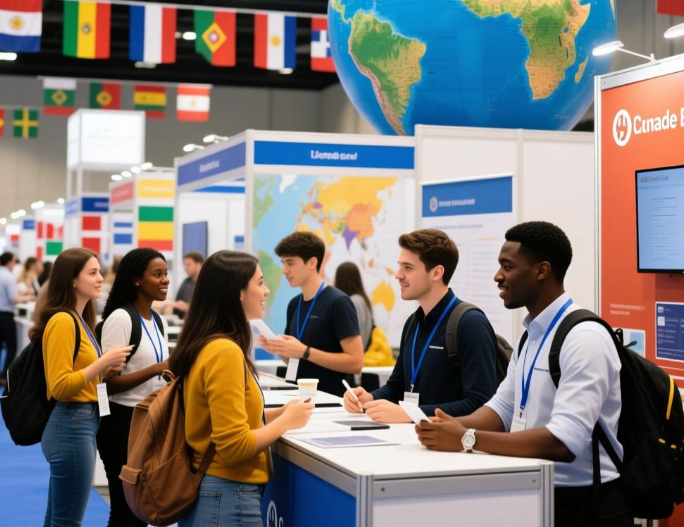
In an era of global educational interconnectivity, study abroad expos have become important benchmarks for understanding the value of international education and planning one’s future. In 2025, study abroad expos held in Shanghai, Wuhu, and other cities attracted global attention. From in-depth dialogues among top universities to the rise of emerging study abroad destinations, from a focus on STEM fields to exploration of a “salary + immigration” dual-track model, these expos not only showcased the global flow of educational resources but also revealed the deeper logic of the return on investment in studying abroad—it is both a numerical game on the economic scale and a strategic layout for personal growth and career development.
Economic return is the most direct quantitative indicator of investment in studying abroad, but the choice of region and major directly affects the return curve. Taking the UK, US, and Australia as examples, the total cost of a one-year master’s degree in the UK is approximately £40,000-£60,000; if one works in the London financial industry, the cost can be recouped within three years. The total tuition for a two-year computer science master’s degree at Stanford University in the US is approximately RMB 800,000; a job as a programmer in Silicon Valley can cover the cost in 3-5 years. The total cost of a two-year nursing master’s degree in Australia is AUD 80,000-120,000; graduates can earn a profit within 2-3 years. However, the returns are significantly divergent: 31% of higher education programs in the US have negative returns, with seven bachelor’s degree programs suffering from investment imbalances due to high tuition fees and a saturated job market; while STEM fields such as engineering, computer science, and nursing have an average return exceeding $500,000, and professional degrees in medicine and law also offer excellent value. This divergence is vividly reflected at study abroad expos—the “3+1” program at Nanyang Technological University in Singapore, the New Zealand government’s investment in STEM and AI, and the surge in consultations for industrial-related majors in Germany all point to one trend: technology-driven majors are becoming a high-return “safe bet.”
The cultivation of career competitiveness is a hidden benefit of studying abroad, strongly supported by recruitment data from multinational corporations. 82% of multinational corporations prioritize candidates with overseas study backgrounds, especially in high-value-added fields such as finance, technology, and consulting, where the international perspective and cross-cultural communication skills of returnees become core advantages. For example, the intelligent study abroad platform showcased by Core Education at the expo integrates academic data from 200,000 students worldwide, providing end-to-end support from major selection to job placement. This technological empowerment is reshaping the time cost of career development. More importantly, the overseas study experience is irreplaceable in enhancing soft skills: 93.1% of returning overseas students believe that the development of critical thinking, teamwork, and leadership exceeded their expectations. These abilities are often more decisive than professional certificates in the interview assessments of tech giants and consulting firms.
The accumulation of cultural capital constitutes the long-term value of overseas study investment. It transcends short-term economic returns and becomes a fundamental ability for individuals to adapt to the wave of globalization. At the study abroad expo, the Russian delegation’s strong engineering schools, the Thai delegation’s ABET accreditation program, and the Malaysian delegation’s specialized colleges collectively outlined a picture of multicultural education. This cross-cultural dialogue not only shapes individual temperament and character but also creates differentiated competitiveness in the globalized workplace—Dartmouth College graduates’ salaries in finance and technology have increased by 300% over ten years, demonstrating the catalytic effect of cultural adaptability on long-term career development. For example, New Zealand’s high school education supports personalized development through elective courses such as arts and sports. When its graduates apply to British universities, the global recognition of A-Level courses and cross-cultural experiences become unique advantages.
The value of study abroad expos lies not only in showcasing educational resources but also in connecting them. Organizations like Shanghai Formote Exhibition Service Co., Ltd., by hosting economic and trade exhibitions for students going abroad, coming to China, and within China, build global bridges for educational resources. From one-on-one guidance from overseas universities at the Wuhu Study Abroad Expo to face-to-face meetings with IELTS examiners at the Shanghai International Education Expo, these activities help families accurately match their needs amidst the flood of information. For example, New Zealand’s “Industry Rules for Guidance and Care of International Students” ensures the safety of students studying abroad by strengthening connections with students and schools; Germany’s concept of “continuity of education” in higher education provides students with a comprehensive development path from undergraduate to postgraduate studies.
As study abroad expos become a “navigator” for educational choices, investment in studying abroad has shifted from standardized products to personalized configurations. The resonance of economic returns, career competitiveness, and cultural capital determines the maximization of investment value. Whether choosing the “high-paying fast track” in STEM fields, achieving a balance between life and career through the “salary + immigration” model, or accumulating lifelong soft skills in a multicultural environment, the core message of the study abroad expo is that the value of educational investment will ultimately be reflected in an individual’s adaptability and creativity in the wave of globalization—it may not immediately translate into a six-figure annual salary, but it will certainly win young people a ticket to a wider world in an uncertain future.